Thursday, May 17, 2018

With Cardinal Dolan’s Approval: Sacrileges, Immorality, and Madness


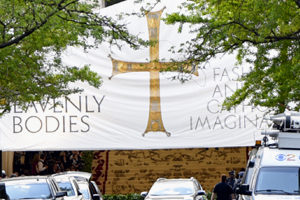
With_Cardinal_Dolans_Approval_Sacrileges_Immorality_and_Madness_300-300x200 With Cardinal Dolan’s Approval: Sacrileges, Immorality, and Madness
With Cardinal Dolan’s Approval: Sacrileges, Immorality, and Madness
On May 7, 2018, the fashion world’s Super Bowl was held at the Metropolitan Museum of Art in New York City.
According to Wikipedia, “The Met Gala. . . is an annual fundraising gala. . . . It marks the grand opening of the Costume Institute’s annual fashion exhibit. Each year’s event celebrates the theme of that year’s Costume Institute exhibition, and the exhibition sets the tone for the formal dress of the night, since guests are expected to choose their fashion to match the theme of the exhibit.1

“Heavenly Bodies: Fashion and the Catholic Imagination”
This year’s theme was Heavenly Bodies: Fashion and the Catholic Imagination, with the Met Ball launching an exhibit with the same name that runs from May 10 to October 8. For both the Met Gala and Exhibition the Holy See lent priceless liturgical vestments and other equally historic sacred objects.
The choice of theme and the exhibit’s design was Andrew Bolton’s, the Costume Institute’s Curator in Charge. Raised a Catholic, he lives with his homosexual partner, Thom Browne. It was Bolton who, over two years of negotiations and numerous trips to Rome, obtained the loan of the Vatican vestments and objects. His efforts received support from Archbishop Georg Gänswein, Prefect of the Prefecture of the Papal Household, Curia Cardinal Gianfranco Ravasi, President of the Pontifical Council for Culture, as well as the First Section of the Vatican’s Office of the Secretariat of State. During the negotiations, Bolton also consulted with the notorious Fr. James Martin, S.J., the “Rainbow Jesuit.”2
“What Is the Cardinal Archbishop of New York Doing Here?”
This question was raised by Timothy Cardinal Dolan himself, a special guest at the Met Gala, in a Press Conference on the morning of May 7.3
The New York Archbishop justified his presence by saying that the Church preaches the true, the good and the beautiful, which come from Jesus Christ, Who is the Way, the Truth, and the Life. Since fashion reflects beauty, in this sense the Church has a connection with it.
What the Cardinal said is true from a purely doctrinal perspective. But he failed to add that true beauty, which proceeds from God, is a chaste, harmonious, and reverent one. He also failed to criticize the nudity and extravagance imposed today by fashion dictators.
Given the immorality of previous Met Gala balls, the Cardinal Archbishop of New York should have known that this year’s Gala was just as unlikely to have any “heavenly bodies” or “Catholic imagination.”4
A Prestigious Platform for Sacrilege, Immorality, and Madness
And what should have been expected indeed happened: The 2018 Met Gala was a fashion extravaganza of sacrilege, immorality, and madness.
No Catholic can be indifferent to Lana del Rey’s sacrilegious parody of Our Lady of Sorrows. This singer, incorporated a representation of the Sorrowful and Immaculate Heart of Mary, pierced by seven swords, atop her bodice. Raised Catholic,5 she declared that from religion “I take what I want and leave the rest.”Looking like an eccentric Jesus figure, actor and singer Jared Leto stood next to her for the pictures, using a lengthy priest stole and wearing a golden crown of thorns.6
Sign Here: Tell the Metropolitan Museum in NYC to Take Down Sacrilegious Exhibit
Nor can any Catholic who is faithful to his baptismal vows not be indignant seeing pictures of Victoria’s Secret model Stella Maxwell wearing a tight strapless column gown stamped with six large icons of Our Lady; actress Sarah Jessica Parker wearing a Neapolitan nativity scene on her head; or actress Zendaya Coleman dressed up as a back-and-cleavage-showing Saint Joan of Arc.
Other models and celebrities in indecent garb displayed halos of holiness over their heads in clear debauchery of the Catholic portrayal of angels and saints.
Ridiculing the papacy, Met Gala 2018 co-host and pop superstar Rihanna appeared in white, crowned with a bishop’s miter and wearing a strapless minidress and robe that revealed her scantily-covered bosom.
Actress Anne Hathaway was dressed in a red cardinal’s outfit, with a bare back and equally indecent, cleavage-displaying front. Rapper Nicki Minaj sported a cardinal-type flowing red cloak, and her impure top was not outdone by the front of her dress which was slit almost to her waist, revealing her bare legs when she walked. To media Minaj declared: “I’m dressed as the devil.” Another Victoria’s Secret model, Taylor Hill, wore a red-trimmed cleavage-showing black dress, a pectoral cross, and what looked like a cardinal’s red sash and pellegrina.
Almost all the women’s dresses were carefully designed to draw attention to intimate parts of the body. Many used transparent fabrics. One woman wore a dress that covered only one side of her body, leaving the other completely naked from head to toe.
Singer Katy Perry, who composed a song titled “Dance with the Devil,” came in a gigantic winged white angel costume and a skimpy golden minidress. Madonna, who has performed the most outrageous blasphemies during her career, came with a crucifix dotted crown, and wearing a black dress with two-and-a-half-inch-wide, see-through, full-torso cut-out Latin cross.
Sign Here: Tell the Metropolitan Museum in NYC to Take Down Sacrilegious Exhibit
Later that evening Madonna performed “Like a Prayer” on the museum’s staircase. Together with the young choristers from the Vatican’s Sistine Chapel who sang in a surprise performance, earning praise from immoral Rihanna,7 Madonna was the night’s most highlighted entertainment.
“I Didn’t Really See Anything Sacrilegious”
Most shocking of all were Cardinal Dolan’s comments to Sirius XM radio8 on Tuesday, May 8, the day after: “I didn’t really see anything sacrilegious,” adding, “I may have seen some things in poor taste, but I didn’t detect anybody out to offend the Church.”
Speaking of Rihanna, who came dressed “as a pope,” the cardinal said she “was very gracious,” and joked about lending her a miter and that she had already returned it. He joked again about this immoral fashion icon administering the Sacrament of Confirmation: “I was teasing my auxiliary bishops, who were teasing me about Rihanna and I said, ‘Hey, you guys should not complain because she’s volunteered to do some confirmations.’”9 The Cardinal was generous in his assessment of the participants: “This was a crowd that was rather respectful of the sacred. They were all very respectful, very interested.”
And he concluded: “Anyway, it was a good time. What a great evening it was.”10
A Bondage Mask Amid the Sacred Vestments
As for the actual exhibit “Heavenly Bodies: Fashion and the Catholic Imagination,” it covers twenty-five galleries and 60,000 square feet.
In it are many mannequins for women with dresses modeled after clerical attire worn by bishops and priests. Many of the dresses are transparent and extremely revealing. Many others include crosses, chalices, Sacred Hearts, icons, and religious imagery. There is also a bondage mask (used in sexual perversions) covered in rosary beads.11One of the dresses featured a short black skirt with a sleeveless top and an icon of Our Lady on the front and back. Another dress, with a mostly transparent top, shows a naked Adam and Eve on its lower part.
“Fashions Will Greatly Offend Our Lord”
The sacrilegious Heavenly Bodies: Fashion and the Catholic Imagination Met Gala and Exhibition remind us of the prophetic words of Saint Jacinta, the youngest Fatima seer. After the apparitions at the Cova da Iria, she received several private revelations, especially when in the hospital in Lisbon, where she later died. One day she told Mother Godinho (her guardian): “Fashions that will greatly offend Our Lord will appear. People who serve God should not follow fashions. The Church has no fashions. Our Lord is always the same.”
She added: “The sins which cause most souls to go to hell are the sins of the flesh.”
With a directly supernatural illumination, this innocent girl, who died before she was ten years old, makes a statement that matches Saint Alphonsus Liguori’s Treatise on Morals almost word for word: “The sin against this precept [the Sixth Commandment]. . . is the vice that fills hell with souls”.12
Modesty Is the First Defense of Chastity
Since the sins of the flesh are the ones that lead most souls to Hell, the obvious conclusion is that all care must be taken to avoid them.
Modesty is chastity’s first defense. It is the enceinte, the curtain wall that defends the castle of purity. It is the garden that leads up to and adorns the palace.
The virtue of modesty leads us to great vigilance when it comes to fashions. For our way of dressing, while reflecting the beauty of virtue in our soul, should avoid everything that would lead others into temptation and sin.
Sign Here: Tell the Metropolitan Museum in NYC to Take Down Sacrilegious Exhibit
Fatima and the Vision of Hell
In the context of the sacrilegious Met Gala and Exhibition, how can we not recall the vision of Hell the three little Fatima shepherds had?
On July 13, 1917, as the first part of the Secret of Fatima, the Blessed Virgin showed Hell in all its horror to the three innocent children, Lucia, Francisco, and Jacinta.
“Sacrifice yourselves for sinners and say very often, especially whenever you make some sacrifice: ‘O Jesus, it is for Thy love, for the conversion of sinners and in reparation for the sins committed against the Immaculate Heart of Mary.’
“Upon saying these last words, she again opened her hands as in the preceding two months. The reflection appeared to penetrate into the earth and we saw, as it were, a sea of fire. Submerged in that fire were demons and souls in human shapes who resembled red-hot, black and bronze-colored embers that floated about in the blaze borne by the flames that issued from them with clouds of smoke, falling everywhere like sparks in great fires, without weight or equilibrium, amidst moans of pain and despair that horrified us and made us shake with terror (that must be when I shouted “aahhi” people said they heard). The devils had horrible and disgusting shapes of scary and unknown animals but were transparent like black burning coals. Scared and as if asking for help, we raised our eyes to Our Lady, who said with goodness and sadness:
“You have seen hell, where the souls of poor sinners go; in order to save them, God wants to establish devotion to my Immaculate Heart in the world.”
May these words of the Mother of God serve to confirm us in the Faith amid the stormy, sacrilegious world in which we live.
166
Footnotes
“Met Gala,” accessed May 11, 2018, https://en.wikipedia.org/wiki/Met_Gala.
Cf. Jason Horowitz, “How the Met Got the Vatican’s Vestments,” The New York Times, May 3, 2018, accessed May 13, 2018, https://www.nytimes.com/2018/05/03/fashion/heavenly-bodies-met-gala-vatican.html.
Jim Fair, “Cardinal Dolan on the ‘Catholic Imagination,’” May 8, 2018, accessed May 13, 2018, https://zenit.org/articles/cardinal-dolan-on-the-catholic-imagination/.
[USE CAUTION in accessing this article’s footnotes] Cf. “Met Gala 2017 Dresses,” Vogue, accessed May 13, 2018, http://www.vogue.co.uk/gallery/met-gala-2017-dresses.
“Lana del Rey,” Wikipedia, accessed May 13, 2018, https://en.wikipedia.org/wiki/Lana_Del_Rey#Personal_life.
Accessed May 13, 2018, https://www.nytimes.com/slideshow/2018/05/07/fashion/red-carpet-pictures-met-gala/s/red-carpet-met-gala-3474-lana-del-rey-and-jared-leto.html.
Claire Giangravè, “Sistine Chapel Choir Hushes then Wows a Raucous Met Gala Crowd, Crux, May 9, 2018, accessed May 13, 2018, https://cruxnow.com/vatican-at-the-met/2018/05/09/sistine-chapel-choir-hushes-then-wows-a-raucous-met-gala-crowd/.
Audio https://soundcloud.com/siriusxm-news-issues/cardinal-dolan-talks-about-the-met-gala-2018.
Joseph Sciambra, “Cardinal Dolan and Rihanna: ‘She’s Volunteered To Do Some Confirmations,” accessed May 13, 2018, http://josephsciambra.com/cardinal-dolan-and-rihanna-shes-volunteered-to-do-some-confirmations/.
Thomas D. Williams, “Cardinal Dolan Says Nothing ‘Sacrilegious’ at Met Gala, ‘All Very Respectful,” Breitbart, May 9, 2018, accessed May 13, 2018, http://www.breitbart.com/big-hollywood/2018/05/09/cardinal-dolan-says-nothing-sacrilegious-met-gala-respectful/.
Cf. Emily Smith, Raquel Laneri and Kate Sheehy, “Catholic-Themed Met Gala Includes Bondage Mask With Crosses,” PageSix.com, accessed May 13, 2018, https://pagesix.com/2018/05/07/catholic-themed-met-gala-includes-bondage-mask-with-crosses/.
Homo Apostolicus, Tractatus IX, De Sexto Praecepto Decalogi.


With Cardinal Dolan's Approval: Sacrileges, Immorality, and Madness

Friday, April 27, 2018

12 Rules for Life: A Book I Wanted to Like -


503px-Peterson_Lecture_33522701146-252x300 12 Rules for Life: A Book I Wanted to Like
Dr. Jordan Peterson delivering a lecture at the University of Toronto in 2017. Author: Jacob Adams
Jordan Peterson’s 12 Rules for Life: An Antidote to Chaos is a book I wanted to like. I wanted so much to favor someone who proposes rules in our times of unrestraint. I see so clearly the need for an antidote to chaos. The fact that his book is on the top of many bestseller lists only made my desire greater. My expectations were high. I wanted to like this book. But I didn’t.
I will admit that the book has valid advice. Some might consider the book engaging and folksy. People like stories that illustrate points and the book is full of them. There are abundant Christian references. I was impressed by some commonsensical observations about childrearing and discipline drawing from his experience as both a parent and psychologist. So many things he said seemed to make sense.

And yet, he failed to convince me. I became uneasy about the many favorable references to Freud, Jung and Nietzsche. There was too much Heidegger and no Saint Thomas Aquinas. There were too many strange formulations about Being (with a capital B) and yin-yang dualism. It was hard to pin him down on how he stands on Christ, truth … or even God.
A Modern Thinker Against Postmodernism
It took a while to figure the book out. But then it clicked.
Dr. Peterson is a modern thinker. He lives in the swirling existential world of thought patterns, narratives and archetypes. He is quite open about this. The book is full of passages that show how life is explained by personal and collective experiences. Everything is about Being with a capital B—whatever that means. He sees life as a Taoist interplay of order and chaos. He defends a Freudian, Darwinian world made in their image and likeness where his rules seem to make sense.
These rules even seem attractive because the Canadian professor’s message is directed againstpostmodernism and “cultural Marxism,” which challenge both his existential world and our own. Thus, he speaks with great passion and even brilliance against a politically correct world gone mad.
For this reason, many have praised the tell-it-like-it-is Dr. Peterson as a forceful voice in defense of order and even conservatism.
Part of the Process Not the Opposition
However, it is one thing to rage against the madness; it is quite another to change the world. And this is where the book falls seriously short.
We cannot return to a Freudian, Darwinian world to find rules for life. That world is part of the problem. Indeed, Nietzsche, Freud, Jung and Darwin (all favorably cited in 12 Rules for Life) are responsible for the more mystical side of our modernity. They banished the supernatural order from society and enthroned a naturalism that sought to explain all spiritual things based on experience and evolved thought patterns. The existential obsession with Being with a capital B and other such concepts sought to replace God and morals. Nietzsche’s famous declaration that God is dead also attempted to decree the death of dogmatic certainty.
Postmodernism is the next step in the process of the West’s intellectual and moral decay. Just as modernity undermined the Church’s supernatural order, so postmodernity denies the naturalistic positions defended by these modern thinkers. Hence, the politically correct denial of reality that Dr. Peterson attacks so well has its origins in much of the thinking he professes.
Bible Stories Fabricated by Our Collective Imagination
Thus, the rules are based on faulty and uninspiring premises that are depressingly post-Christian.
We are told, for example, that our Biblical texts are not the inspired Word of God but merely allegorical narratives “coding our observations of our own drama” and embedded in shared stories.
Dr. Peterson continues: “The Biblical narrative of Paradise and the Fall is one such story, fabricated by our collective imagination, working over the centuries. It provides a profound account of the nature of Being, and points the way to a mode of conceptionalization and action well-matched to that nature.”
Indeed, even the notion of a personal God is part of a fiction. “Our ancestors acted out a drama, a fiction: they personified the force that governs fate as a spirit that can be bargained with, traded with, as if it were another human being. And the amazing thing is that it worked” (emphasis his).
Dr. Peterson’s abundant Christian references and citations are all made in this context, mixed with similar references to other religious “stories.” Religion is not about man’s relationship with God but it “is instead about proper behavior” (emphasis his).
Rules in Esoteric Trappings
Thus, the substrata of the 12 Rules for Life I tried to like is based on this existential framework of reality. The rules themselves are experience-based directives, not moral imperatives. We are asked to derive inspiration from rules like number one which says: Stand up straight with your shoulders back. Rule 5 says: Do not let your children do anything that makes you dislike them. And what are we to make of Rule 11, which says: Do not bother children when they are skateboarding or rule 12: Pet a cat when you encounter one on the street?
Even the advice found in these rules, which seems so practical, is enveloped in esoteric trappings. After telling his stories, Dr. Peterson inevitably enters into notions of Being with a capital B or other existential jargon highlighting the plight of the individual in an unfathomable universe without certainties. He invites us, for example, to have faith, which he calls an “irrational commitment to the essential goodness of Being.”
The bottom line is that “we must each adopt as much responsibility as possible” and thus “we can and must reduce the suffering that poisons the world.”
Such advice may feel good, but it is hardly an antidote to the chaos that is devouring the world.
A Missing Link with the One True God
Missing is the link to the one True God Who desires our salvation. This is the problem with the 12 Rules for Life book I tried to like. There is no link. We are on our own and can expect no help from beyond.
Our fallen nature is not a shared story but a tragic reality for which we need concrete and supernatural help from Heaven to help us fight the chaos that threatens to overwhelm us.
Dr. Peterson and those who rave over his rules seem oblivious to the means of sanctification and salvation that the Church extends to us for this purpose. The power of prayer is immense to those who confide in God. The sacramental life nourishes and strengthens us in our daily journey. The grace of God allows us to do that which mere nature cannot do. These are truly antidotes to chaos.
What is needed is not abstract Being with a capital B but a personal, infinite, eternal, and transcendent God with a capital G.
As seen on Crisis Magazine.


12 Rules for Life: A Book I Wanted to Like - by John Horvat

Tuesday, April 3, 2018

Why Are Young People Killing Young People?

In the marches, walkouts and debates over gun violence, young people claim to be victims. Some even say they are the only valid, even prophetic voice speaking out. However, one question goes unanswered: Why are young people killing other young people?
There is so much talk about the responsibility of bad politicians, National Rifle Association members and corrupt officials. However, none of these have ever killed young people.
Inside the youth culture, the mass murderers are mostly young men killing members of their own generation. There is something wrong inside a youth culture in which young people kill other young people.

Responsible for Their Acts
As all people are endowed with free will, these young people alone are also responsible for their acts. No one forced them to kill other young people. It was their decision.
However, those responsible for the killings can be influenced by others. Aside from family, the most important influence upon young people are usually other young people.
Indeed, youth culture is known for its rejection of outside “grown-up” influences. The fire of youth exalts in its incredible energy and desire to be independent of the older adult world. Thus, there must be some factors inside today’s youth culture that help explain why young people are killing young people.
Factors that Influence These Acts
The youth culture in question is the dominant pop culture as promoted by media and lived by youth idols and stars. It is the product of successive generations that have succumbed to the sexual revolution model introduced during the sixties. It is not necessarily how all young people live, but it does exert much influence on their lives.
It manifests itself in how youth think and express themselves, how they dress and what fads and fashions they follow. It is found in the music they listen to and the media they frequent.
There are three factors of this present youth culture that can be cited as influencing the violence.
A Self-Centered Culture
The first is that this popular youth culture is extremely self-centered. Everything is thought to exist in function of the individual. Persons can, for example, self-identify as whatever they wish to be. Individuals determine the terms of their own existence, behavior and values.
This creates an artificial and insecure world marked by self-gratification. In this culture, young people want everything instantly, effortlessly and regardless of the consequences. They have no patience with anything that stands in the way. They are easily offended by any certainty or moral standard that “micro-aggresses” them.
With the advent of social media, this self-centeredness is represented by an enormous pressure upon young people to project a self-image beyond reality. Social success is measured in validating texts, self-absorbing posts and impulsive likes. The selfie has become an expression of self-projection.
What Does Saint Thomas Say About Immigration?
In such a climate, concern for others is diminished, and people can quickly become ostracized. Those who fail to live up to the image of their self-aggrandizement become depressed and resentful. With few moral restraints, it can give rise to situations when young people kill other young people.
A Dearth of Meaningful Relationships
The second factor in contemporary youth culture is a dearth of meaningful relationships. It is no secret that many youths come from homes broken by divorce. Others grow up lacking one parent. These essential family relationships are foundational for the development of a stable personality. The profile of the mass murderers almost always reveals the lack of a good father and other important role models.
Outside the family, this popular youth culture also tends toward superficial links. This is especially seen in the casual sexual relationships that are facilitated by certain linking up apps. Social media adds to the shallowness with its offer of friends and followers that add little to social life.
The instability of relationships is further reflected in a lack of community involvement that sociologists have noted among youth. They lack those community links that normally add an extra layer of stability to personal development. The troubled individuals involved in the killings are generally loners without significant integration in the community.
Despite an incredibly interconnected world, there are those feeling entirely isolated, tormented by apathy, boredom, and restlessness. Such a situation creates the lonely conditions for the appearance of young people that kill other young people.
Looking for Causes Beyond Self
Finally, a self-centered materialist culture is asphyxiating and shallow. It especially suppresses the spiritual desires of the youth that naturally looks for causes beyond self and ultimately toward God.
That is why successive generations of youth since the sixties have looked for increasingly abnormal outlets for their spiritual hunger: drugs, religious sects, and bizarre lifestyles that so destroy their lives. The present generation has taken this same impulse farther by embracing the occult. Some even enter the macabre world of Islamic radicalism—found among some young shooters.
What Does Saint Thomas Say About Marriage?
When spiritual desires are absent, it can also give rise to emptiness. Saint Thomas Aquinas (Summa II-II, q. 35) calls this condition acedia, which he defines as the weariness for holy and spiritual things and a subsequent sadness of living. This tragic emptiness is often found among those young people killing other young people.
Return to Christian Order
The only way to fight today’s corrupted youth culture is to replace it with another culture. This other culture must be contrary to the present one. It must be powerful enough to inspire selflessness, embracing enough to engender community, lofty enough to arouse dedication. It must be a refreshing alternative to a sad and weary world.
This effort to find a culture does not involve a search but a return. Christian order had this inspiring effect upon decadent Rome and countless other barbarian cultures. It united peoples in charity and captured their imagination as they joined their hearts and mind to God. Nothing could have been more unlikely than this new culture in those morally devastated peoples. But if it happened once, it can happen again, even in these unlikely times when young people kill other young people.


Why Are Young People Killing Young People? -

Thursday, March 29, 2018

Dealing with a Walk-Away World


A colleague told me of an intriguing incident at a conference of accountants that were studying recent changes in tax regulations. One speaker gave a talk on recruiting new staff and how to deal with turnover. An attendee then asked a question remarking that from the context of her presentation, it seemed companies were facing recruiting cycles of two or three years, especially from new graduates.
The speaker replied that this was true. The newer generations tend to migrate to other jobs quickly and unexpectedly. The days of stable employment lasting decades or even a lifetime are over. Today’s recruits will frequently walk away from a job just as a change of pace.
The questioner responded by saying that surely the employee could be retained by an offer of more money. The surprising reply was that money did not seem to make a difference. Sometimes the new job paid less or involved different skills. An accountant, for example, might migrate to being a receptionist because he or she just prefers to do so. The changes appear almost whimsical. While not every person will necessarily follow this pattern, the speaker said to expect people to make these walk-away decisions after only two or three years on the job.
The conversation impressed me but did not surprise me. I had witnessed this instability in my interaction with others including younger people. However, this striking example at a conference for serious accountants got me thinking. Everything seemed to click: Ours is a walk-away world.
Living in Ambiguity
Our walk-away world is an ambiguous place where people do not like to define things. They prefer to act upon impulses.
I do not blame this walk-away world on the new generation. In fact, I think it is the product of successive generations, including my own, that have succumbed to the intemperance of our times. We want everything now, instantly and effortlessly. We expect our desires to be gratified at once. We manifest immediate annoyance when they are not satisfied instantaneously. We are accustomed to walking (or clicking) away.

This world is not like that of more defined generations of the past with their radical rhetoric and activism. They took defined philosophical stands and enlisted impassioned youth to advance their causes. Their radical stands expressed the immobility of their positions, their refusal to concede to pressures.
However, in a walk-away society, everything is based on emotion, image, and impulse. Today’s #hashtag activism is short-lived and empty of meaning. Activists seamlessly walk away from the thrill of a one real or fake crisis to the next. In our frenzied news cycles, ideas are rarely debated rationally. When something offends activists, they simply walk away from the “microaggression” or problematic truths that invite their mature reflection and judgment.
The Destruction of Institutions
I believe one of the main reasons why people walk away is found in the breakdown of institutions. In a short period of fifty years, people have been given the option of walking away from the institutions that anchor us in reality.
It was once understood that society could not survive without the institutions of family, community, and faith. This understanding kept society cohesive, prosperous, and ordered. When this notion of order was challenged in the 1960s, it unleashed today’s fragmented and anchorless world.
So many other institutions suffer from similar devastation. Nicholas Eberstadt in his book, Men Without Work, laments the walking away of millions of men from “what we think of ordinarily as adult responsibilities not only as breadwinners but as parents, family members, community members, and citizens.” He rightly characterizes this abandonment of duty and responsibility as “infantilization.”Thus, everything has become walk-away. Cohabitation, adultery, same-sex unions, rampant divorce, and other evils make for walk-away marriages and families. Contraception, sterilization, and abortion are nothing but walk-away parenting.
Indeed, others like Sen. Ben Sasse have written about youth who “adult,” which means to do a specific adult action while insisting upon remaining an adolescent. Sociologist Robert Putnam has documented the dramatic increase of those who walk away from all forms of civic involvement.
Walking Away from Truth
As dangerous as the walk away from institutions is, the walking away from the truth is worse. Institutions anchor us in reality, the knowledge of the truth encompasses how we know reality.
It is symptomatic that we live in “post-truth” times. In 2016, the Oxford Dictionaries awarded the term its “word of the year.” Rebecca Goldstein notes that in their commentary on “post-truth,” the Oxford editors pointed out that “post” in this context did not refer to a subsequent time reference “as in postwar or postgame” but rather to something that has become “unimportant or irrelevant.” People have not necessarily denied the truth but just walked away from it.
Again, this walking away was facilitated by opening up the option of walking out. It was caused by the abandonment of the Western canon of literature, logic, and philosophy that is the basis of modern thought. This “liberation” ended up fragmenting what was once unified thought into a restless search for whatever pleases.
Today’s man walks away from the discipline of definition and logic. We accept the most blatant contradictions and blurring of distinctions. It gives rise to the fake news that destroys certainties. There is a shallowness of thought that is facilitated by social media. Changing from one experience to another is just a click away.
The walk away from the truth is particularly seen in the deconstruction of identity in which people question who they are. They self-identify as whatever they imagine themselves to be. Some even go to the point of fragmenting into several identities, “genders,” or online avatars based on the whim and imagination of the moment.
The Walk Away from God
The worst devastation of our walk-away society is found in the walk away from God. It is only through love and knowledge of the Creator that we find meaning and purpose in life. We are made for God, as Saint Augustine says, and our hearts are restless until they rest in him.
Our society does everything possible to facilitate this walk away. Many are the false gods in our modern pantheon—individualism, materialism, health, wealth, hedonism and others. There is no more hellish existence than the worship of these false gods, which will always deceive and never keep their promises. However, the worst of these gods is when people set themselves up as gods. They then experience the tyranny of their enslaving passions.
The walk away from God is made worse by the crisis inside the Church that has confused and led so many astray. People no longer find the certainty they crave. Instead, they stumble into new theological trends that promote a walk-away morality. They find infantile services, which represent a general walk-away from our duty to worship God. A feel-good spirituality walks away from the Way of the Cross. Even the idea of God is no longer a just yet benevolent God but a being that suits our every fancy.
Restless and Searching
Thus, it is no surprise that people are frustrated—even in the business world. It should astonish no one that young people are so affected since they are empowered with an increasing number of ways of walking away. This can especially be seen in our culture’s obsession for escape found in the experience of drugs, sexual promiscuity, and virtual fantasies.
However, it is this ever-increasing restlessness that might provide a response to our walk-away world. When societies lose their bearings, they often generate an intensely contrary movement whereby people start pondering their origins, purpose, and fundamental assumptions. In this case, it would be the Christian wellspring from whence they came. Some people in our walk-away world are now searching for causes to embrace. In spite of the crisis, they look to the Church for the faith, hope, and charity they lack. With the discreet help of Divine Grace, they seek out the God from whom they once fled.
More importantly many are coming to realize that the problems we now face have no human solution. They are so grave and ubiquitous that there is no walking away from them. They then learn that the only solution is to confide in God and the Blessed Mother, especially in light of the Fatima message. They will never walk away from us.
Dealing with a Walk-Away World - Return to Order:

Tuesday, March 20, 2018

Praying a Counter-Cultural Rosary on the Frontlines of the Culture War

By John Horvat II

As I stood on the country highway praying a rosary for marriage, I could not help but think I was on the front line. Talking about traditional marriage is essential, but it can be done from the safety of the home. Writing about the subject is an exercise done in the isolation of an office. When you are out in front of hundreds of passing cars or pedestrian traffic, that is the front line.
Anything can happen since this is an explosive topic. You are out there directly exposed to those who hate you. You will also experience the consolation of support. You will face the contempt of indifference. You are in God’s hands.

An Ordinary Site Made Extraordinary
On March 17, I participated in one of over 2,247 public square rosaries in defense of traditional marriage nationwide. It involved gathering together a group of people in a public place on the closest Saturday to the feast of Saint Joseph. Each rally had a banner that proudly proclaimed: “God’s Marriage = 1 Man + 1 Woman.” The event was sponsored by the America Needs Fatimacampaign of the American Society for the Defense of Tradition, Family and Property.
The location of our rally could not have been more American. We were out in the countryside amid cornfields, pastures and grain silos. However, it was a busy highway with all sorts of Americans going about their Saturday tasks and shopping. There were semis, pickups, minivans, cars and even tractors passing by our rosary rally for marriage.
Protected by our traditional marriage banners we prayed Our Lady’s rosary. The rally was organized by a family with three generations present. The most enthusiastic were the children who appeared to marvel at the excitement of praying in front of everyone. The grandmother watched over the children as the father bravely and loudly led the mysteries.It was not a particularly beautiful spot. There are certainly more symbolic locations. The flat area at the side of the road usually serves as a parking spot for commuters. It provided ample space for our rally.  Perhaps it was the ordinariness of the site that made it so extraordinary. It showed that America’s rejection of same-sex “marriage” is deeply rooted.
r
The Utter Audacity of it All
It takes courage to pray the rosary in the public square. There will be people passing by who know you. Some of them will disagree with you and talk about you behind your back. There will also be others who will secretly admire you and in the silence of their cars wish you well.
As we started to pray, I sensed the utter audacity of it all. Our protests do not enjoy the patronage of a fawning media that gives its support to liberal causes. I am convinced that it takes the help of supernatural grace to venture out on the public square.
Thus, praying a rosary in the public square is counter-cultural. In the secular society envisioned by most liberals, these public displays of prayer are not supposed to happen. They are not politically correct. No one is allowed to disagree with same-sex “marriage” publicly. However, those in the hundreds of cars that passed us, all took a mental note that it is possible to disagree in public.
I could not help but think of the multiplier effect of these rallies. It was not just our rally in the middle of the countryside but 2,247 of them across the nation, each broadcasting its counter-cultural message far and wide.
.
Defying the Liberal Narrative
I was impressed by the different narrative I found on the front lines of the Culture War. Based on the news reports and polls spread by the media we could expect overwhelming rejection of our message. But that is not what we found.
As we prayed, the overwhelming majority of those who reacted were favorable. They gave us the thumbs up. They honked their horns and shouted their support. One older farmer came to the lot to pick up a car. In his picturesque way, he told us he agreed with us to the point that he would like to buy us each a case of beer.
Of course, there were those who disagreed with our prayer rally, but they were surprisingly few. As the traffic zoomed past, they would let loose a foul expletive that was thankfully difficult to discern. Such rare and cowardly displays of opposition usually had the effect of only making us more resolute in our purpose to stand up for God’s marriage.
Thus, we finished our public square rosary for marriage. Just as there was no media narrative on the frontlines, no media reported on the event. Such displays of public piety, no matter how extraordinary, escape their radar. However, such negligence is not important. Unlike liberal street theater, our rallies were not done for media consumption. They were done to instill hope in those who share our Faith. Above all, our rosary rallies were directed to God, the Blessed Mother and Saint Joseph, in whom we confide for the final victory
.
 Praying a Counter-Cultural Rosary on the Frontlines of the Culture War