Monday, April 19, 2010

No Fasting Allowed During Eastertide!

Sunday April 18th, if you stood on the street corner and asked; Is Easter over? How do you think people would answer?

From Dom Guerenger "The Liturgical Year" Pascal Time Book II Vol. 8 page 11-12.

The fifty days between Easter and Pentecost have ever been considered by the Church as most holy. The first week, which is more expressly devoted to celebrating our Lord's Resurrection, is kept as one continued feast: but the remainder of the fifty days is also marked with special honors.

To say nothing of the joy, which is the characteristic of this period of the year, and of which the Alleluia is the expression- Christian tradition has assigned to Eastertide two practices, which distinguish it from every other season. The first is, that fasting is not permitted during the entire interval: it is an extension of the ancient precept of never fasting on a Sunday, and the whole of Eastertide is considered as one long Sunday.

This practice, which would seem to have come down from the time of the Apostles, was accepted by the Religious Rules of both East and West, even by the severest. The second consists in not kneeling at the Divine Office, from Easter to Pentecost. The Eastern Churches have faithfully kept up the practice, even to this day. It was observed for many ages by the Western Churches also; but now it is little more than a remnant. The Latin Church has long since admitted genuflection's in the Mass during Easter time. The few vestiges of the ancient discipline in this regard which still exist are not noticed by the faithful, inasmuch as they seldom assist at the Canonical Hours.

Friday, April 16, 2010

Reflections on the Sexual Abuse Scandals in Europe


Written by Luiz Sérgio Solimeo

Share
The sins of the Church’s human members do not sully the sanctity of the Church, Her sacraments, doctrine, or institutions.

With the media uproar over sexual abuse scandals now raging in Europe, it is fitting to reflect on what is happening and how faithful Catholics should react.

A Heinous Crime
We should begin by stating outright that there is nothing so heinous than the sexual abuse of an innocent child. No one has been more severe against this than Our Lord Jesus Christ: “But he that shall scandalize one of these little ones that believe in me, it were better for him that a millstone should be hanged about his neck, and that he should be drowned in the depth of the sea” (Matthew 18:6).

Thus no one should have more indignation and severity against this kind of abuse than Catholics. This indignation is compounded even more if the perpetrator is someone that, by his Holy Orders or religious vows, established a special relationship with the Savior and assumed a special commitment whereby he, in some manner, symbolizes the teachings and morals of the Divine Master.

For this reason, these scandals that have shaken the Church are considered by devout Catholics as not only a criminal offense but also a heinous sin.

We must not also forget that aside from the crime of abuse, there is also the fact that these acts were tolerated by some ecclesiastical authorities or even, covered up by them. Some of the criminal priests were transferred from one parish or school to another, sometimes committing the same odious acts again. In light of these facts, all parties concerned must be censured and punished, but not the institution itself, which is holy and hierarchical and instituted by its Founder.

Act II of the Same Play?
The similarity of the present uproar with the American crisis in 2002 leads us to ask if the present efforts, and especially those attempting to involve the Pope, do not also point to some de facto association among liberal journalists and dissident Catholics in an attempt to change the Church from an hierarchical to a democratic type of Church government. The similarities of the tactics used appear to be acts from the same play.

This possible association does not diminish in any way either the gravity of the sins committed or the holy indignation merited by the scandals. However, it does explain some aspects of a truly worldwide campaign that circulates the same suggestions and pressures to change the Church by pressuring Her to conform to the “morals” of the secularized world.

The principal media organ that is leading the latest uproar in Europe is the German weekly magazine Der Spiegel. In its international online English edition (02/08/2010), we can see articles with titles like “Shame and Fear: Inside Germany’s Catholic Sexual Abuse Scandal,” which is signed by the “Der Spiegel Staff.”

At the same time that some abuse cases are described with shocking graphic details, the anti-Catholic and anti-clerical approach of the article is also clear. It presents the Church as an outdated institution with repressive morals. It cites the Church’s position on homosexuality, celibacy and its hierarchical structure as the cause of the pedophile scandals. They quote dissident theologians such as Hans Kung and Eugen Drewermann as experts and refer to fringe groups like We Are Church, to opine about the model of Church that needs to be established.

The article criticizes the “Catholic Church’s claim to being a superior moral authority.” For Der Spiegel, the sexual scandals are the fruit of the Church’s “repressed sexual morality that is dictated from above.” Former Catholic theologian Hans Kung gives his opinion: “If you are forced, by virtue of your profession, to live a life without a wife and children, there is a great risk that healthy integration of sexuality will fail, which can lead to pedophile acts, for example.” The opinion of ex-priest Eugen Drewermann finds fault with a “church structure that is repressive in emotional areas and on questions of love.”

Another “expert” is Wunibald Müller, presented as a theologian and psychotherapist, and who defends homosexuality and a “mystical eroticism.” He claims “the experience of pain and suffering can lead us to God, but so can eroticism and sexual passion.” He sees no problem with sexual relationships, but only with “an ‘immature homosexuality’ that makes some priests ‘susceptible’ in their interactions with young people.”1

Finally, the dissident movement, We Are Church, complains of “a structural problem, in which strict sexual morality and an authoritarian system combine to form a dangerous mix.”2

Echoes All over Europe
The Der Spiegel article is echoed all over Europe. We find the same arguments attacking Church morals and governing structures as were circulated in the United States in 2002 and in some cases the same “experts.”

Following Der Spiegel’s example, we can cite Peter Popham, religious writer for the English newspaper The Independent, (March 15, 2010). He writes a long chronicle of the clerical sexual scandals tinged with progressivist jargon, defending a “modernized” Church and even going so far as to call the Pope a “former Nazi.”

The Italian newspaper Corriere della Sera (March 16, 2010) noted that “the [Catholic] progressivist movement ‘Initiative Kirche von Unten’ (Church from Below Initiative) asked directly for Benedict XVI’s resignation…” The paper also cited the dissident movement We Are Church.

Simon Sturdee of Agence France-Press (03/17/2010) claims that “senior Church figures in Germany … called for priestly celibacy to be reviewed…”

A very well-read religious blogger from England that uses the pen-name of “Archbishop Crammer” (March 16, 2010) reviewed the extent of the world media uproar and asked: “Is Pope Benedict XVI about to Resign?” Introducing the links to his long list of articles, he adds: “Well, he is under a little pressure.”

Scandalous Coverage
Such coverage does not address the central issues. Instead of citing how the heinous crimes that were committed and their cover up go against Church teaching and structures, these self-proclaimed theologian-journalists allege that Church teaching and structures are the causes of the crimes! Instead of showing how unrestrained sexuality is part of the problem, these commentators put forth ending the “sexual repression” as part of the solution.

Moreover, we might mention a curious comparison. From 1995 up to the present, there have been 210,000 sexual abuse cases with minors in Germany. Of these, only 94 cases involved the clergy – only 0.044% of the total cases. We are led to ask why Der Spiegel and so many other publications only talk about clerical sexual scandals as if the clergy was the only, or principal cause of the sexual abuse of minors.3

With such inconsistencies, we are compelled to ask if the international media uproar over the clerical sexual scandals is being done for the good of the Church and the faithful or if there is some other agenda being promoted, again, aiming at reforming the institution as it is today and has been for 2000 years.

The Spirit of God is Not in Sensationalism
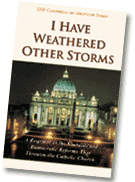
In the book I Have Weathered Other Storms – A Response to the Scandals and Democratic Reforms That Threaten the Catholic Church, the TFP Committee on American Issues had already denounced in 2002 the strange liaison of liberal media with dissident Catholics who take advantage of the tragedy of sexual abuses to attempt to transform the structure of the Church into something which is contrary to Her traditions and the wishes of Her Founder, Our Lord Jesus Christ.

We note that Pope Benedict XVI in his Pastoral Letter to the Catholics of Ireland, without mentioning liberal media or dissident Catholics, deals with the issue in a serene and supernatural manner which is so contrary to the “scandal-mongering” tone of the media and dissidents. God is not found in sensationalism and agitation (cf. 1 Kings 19:11-13).

To Chastise but to Give Hope
The Pope’s letter chastises those priests and tolerant bishops responsible for the scandals. It uses powerful language to qualify their actions and supports both canonical and civil sanctions against them. At the same time, he does not abandon them and insists on the power of repentance and penitence united with the sufferings of Jesus Christ since there is no sin without pardon.

The letter emphasizes the need to return to the Faith, a true life of piety, devotion to the Blessed Mother and Blessed Sacrament and a greater love for the Church. It is not by breaking with the Church or dreaming up a Church different from the one founded by the Divine Savior that we can come out of the crisis.

He counsels all Catholics everywhere that, “[a]s you take up the challenges of this hour, I ask you to remember ‘the rock from which you were hewn’ (Is 51:1).” Catholics should remember the Faith of our fathers and all that the Church has done: converting the pagans and barbarians, creating the institutions like hospitals and universities, and reaching out to the poor.

The Church has “Weathered Other Storms”
Yes, the Church has “weathered other storms.” In the midst of the present crisis, we must follow the counsel of St. Paul: “Put you on the armor of God that you may be able to stand against the deceits of the devil.” (Ephesians 6:11).
other_storms.gif


To purchase a copy of I Have Weathered Other Storms - A Response to the Scandals and Democratic Reforms That Threaten the Catholic Church, click here.


Thursday, April 15, 2010

Finding the Real Soul of the Apostolate

Written by Norman Fulkerson

The present scandals in the Church have many people looking for positive solutions to the multifaceted problems which beset the Bride of Christ, not realizing that the true solution will only come from Our Lord Jesus Christ Himself, His life within us and fidelity to His teachings. The Soul of the Apostolate is a book, which not only shows how this is possible, but the way it is to be accomplished.

No commentary on this book would be complete without a word about its author. Jean-Baptiste Chautard was born in the French Alps on March 12, 1858. His father was a nominal Catholic who ran a little bookstore, but his mother made sure that their children were educated in the Catholic faith. Jean Baptiste eventually went on to study economics at the University of Marseilles where he had an experience which would change his life forever.

While walking across the campus one day Jean Baptiste happened upon a priest praying his breviary. This priest was unaware of the impression he was making on the economics student. "His bearing, full of respect and religion, was a revelation to me," said Dom Chautard, "and produced in me an urgent need to pray from then on, and to pray in the way this priest was praying. The Church appeared, concretized, so to speak, in this worthy minister, in communion with his God."

This incident led Jean Baptiste to change his life and become a man of prayer. Such is the impact of a man who truly practices the interior life. Only then can the person say with Saint Paul, "I live, now not I, but Christ liveth in me."

Later he joined a Catholic club on campus founded by the saintly Father Jean-Joseph Allemand. It was in this association that he found the supernatural brand of Catholic Action which solidified him in the path towards a greater union with God. One day while in prayer at the tomb of Father Allemand, he received his calling to the priesthood and in 1877 entered the Trappist Abbey of Aiguebelle, north of Avignon.

Jean Baptiste did not enjoy the contemplative life of a monk for long. Shortly after being made deacon, his superior sent him on a very important mission to Paris to save the community from financial ruin. His eloquence and knowledge of economics proved useless in this undertaking. He was forced to have recourse to a nearby shrine where he threw himself at the feet of Our Lady of Victories. Thirty minutes later, he emerged from the shrine to be greeted by a total stranger. "Are you a Trappist?" the man asked. "Can I be of any assistance to you?" The rest of the story can be guessed. Aiguebelle was saved and Jean Baptiste learned another valuable lesson he would later utilize in forming his unique spirituality.

He was eventually ordained and became "Dom" or Abbot Chautard of the motherhouse of one of the most important abbeys of the Trappist Order, Sept-Fons.

In the first decade of the 1900's he was faced with another great challenge. The Church in France was attacked by the French Government, this time under Georges Clemenceau, who because of his hatred for Church, closed down many religious orders in France. Abbot Chautard however faced Clemenceau and his enemies with such fearlessness that the order was spared.

Reflecting on the persecutions against the Church at that time, Dom Chautard noticed a big mistake among Catholic leaders of the time. They were fighting against the enemies of the Church by using worldly and political weapons: newspapers, magazines and conventions. The growth of the Church was measured by the amount of new buildings being built and the amount of money in the coffers. While these material means are helpful and even necessary these Catholics failed to realize that God's Church is above all built of living stones not just mortar and brick. Success was measured in very materialistic terms when what the Church really needed were saints. But saints are made only by the grace of God.

In 1907, Dom Chautard published a little pamphlet titled "The Apostolate of Catechism and the Interior Life." He pointed out that the most important ingredient for the rebirth of zeal in a country where the Church is being persecuted is the preaching of the fundamentals of the Faith by people imbued with the interior life. The arguments in this little treatise formed the cornerstone for The Soul of the Apostolate.


The book is quite simple, containing very profound yet long forgotten truths. Its fundamental goal is to convince the reader that "we must never leave the God of works for the works of God and that Saint Paul's: 'Woe unto me if I preach not the Gospel', does not entitle us to forget: 'What does it profit a man, if he gain the whole world and suffer the loss of his own soul?'"
Through scripture passages and the lives of the saints, Dom Chautard shows that interior life is neither lazy nor selfish.

With an abundance of scripture quotes and examples from lives of the saints, Dom Chautard shows how it is possible to preach the Gospel and save one's own soul, by becoming real men of interior life. He gives powerful arguments to back up this point and proves how interior life is not lazy, selfish or detrimental to a truly fruitful apostolate done for the salvation of souls.

To understand the effectiveness of interior life, consider the fact that, "a single burning prayer of the seraphic Saint Theresa (as learned through a highly creditable revelation) converted ten thousand heretics." Without leaving her convent, she did that which "activistic heretics," even the most eloquent ones, could never do.

A bishop of Cochin-China once said to the Governor of Saigon: "Ten Carmelite nuns praying will be of greater help to me than twenty missionaries preaching."

The bottom line is there must be a harmony between the active life and the interior life. Saint Bernard explains this balance using the very interesting metaphor of the reservoir and the channel. "The channels let the water flow away, and do not retain a drop. But the reservoir is first filled, and then without emptying itself, pours out its overflow, which is ever renewed. We have many channels in the Church today," Saint Bernard added sadly, "but very few reservoirs."

The devil however knows the value of interior life and will often grant the apostle "a purely superficial success" if he can only prevent him from making true progress in the interior life. Dom Chautard calls these "successes" sapphires then wisely points out that the devil will gladly trade a few sapphires of the active life for the diamond of interior life.

The interior life is very well defined as "the state of activity of a soul which strives against its natural inclinations in order to REGULATE them, and endeavors to acquire the HABIT of judging and directing its movements IN ALL THINGS according to the light of the Gospel and the example of Our Lord."

Such seriousness about spiritual matters would be impossible without something Dom Chautard calls "custody of the heart." - the "habitual or at least frequent anxiety to preserve all my acts, as they arise, from everything that might spoil their motive or their execution."

To keep such a strict custody over the heart and therefore practice a solid interior life, one must absolutely avoid letting the agitation of daily life disquiet the soul and lead to dissipation. That is why Dom Chautard gives so much importance to rising, when possible, at the same time every morning, and beginning the day with morning mental prayer.

He who faces the day by hitting the floor running, really does not believe in his fundamental contingency on God. Dom Chautard rebukes such people saying, "To hear these mighty men of works talking about their exploits, one might imagine that God Almighty, to Whom it is child's play to create worlds, and before Whom the universe is dust and nothingness, cannot get along without their cooperation."

Such is the importance of morning mental prayer for those who want to attain a vibrant interior life that St. Theresa of Avila said that, "he who practices mental prayer has traveled half the journey. However he who does not practice at least fifteen minutes of mental prayer a day is an animal."

This may seem like "pie-in-the-sky" considerations for all those who look upon the present situation in the world and Church and yearn for action. They see prayer and contemplation as a waste of good time.

This is not true. The power of the interior life is impressive. Is it not true that tepid souls suddenly become fervent? The mysterious wind of supernatural life fills the sails of their souls once again and no one seems able to explain what caused such a transformation. Likewise, no one could explain how Jean Baptiste, the economics major, became a priest and later abbot of the most important abbey of the Trappist order, facing and overcoming the obstinate Clemeceau along the way.

One cannot logically explain how such a transformation could take place except with the doctrine so admirably laid out in his book The Soul of the Apostolate.

Such spiritual change is open to all men, even those most weighed down by the trials and tribulations of the modern world. Dom Chautard affirms this truth when he says, "No matter what my condition may be, if I am only willing to pray and become faithful to grace, Jesus offers me every means of returning to an inner life which will restore to me that intimacy with Him."

Oh, with what sweetness does he illustrate how the words of Isaias will be fulfilled in those who acquire such intimacy. "Then shall thy light break forth as the morning, and thy health shall speedily arise, and thy justice shall go before thy face, and the glory of the Lord shall gather thee up. Thou shalt call, and the Lord shall hear, thou shalt cry and He shall say: 'Here I am.' And the Lord will give thee rest continually, and will fill thy soul with brightness and will deliver thy bones, and thou shalt be like a watered garden, and like a fountain of water whose waters do not fail."

You can buy this great book by clicking here

Tuesday, April 13, 2010

Ask Notre Dame to Cancel "Day of Silence" and Other Pro-Homosexual Events

By TFP Student Action
April 11, 2010
Notre Dame Dome
Ask the Board of Trustees to cancel pro-homosexual events on campus.

The dictatorship of relativism is alive at the University of Notre Dame. While the 88 pro-lifers who peacefully prayed on campus during the 2009 commencement fiasco still face charges and possible jail time, the homosexual movement is welcomed.

sign-the-protest


From April 12-16, Notre Dame plans to host a pro-homosexual "Stand Against Hate Week." According to the promotional flier, the events are being sponsored by various groups, including the Office of the President (Fr. John I. Jenkins, C.S.C.), the Office of Student Affairs, the Core Council for Gay, Lesbian, Bisexual & Questioning Students, the Feminist Voice and Campus Ministry.

Why should any Catholic university cater to the homosexual movement's agenda and sow moral confusion among students?

Ask ND's Board of Trustees to cancel the events

The week-long program mentions a screening of the pro-homosexual film "The Laramie Project," a lecture in the Carey Auditorium titled "Homosexuality Under the Dome: Past Struggles and Present Solutions," free t-shirt distribution, and finally a "Day of Silence" on April 16.


Important to remember is the fact that the "Day of Silence" is a pro-homosexual propaganda tool designed by GLSEN (Gay, Lesbian and Straight Education Network) to persuade young school children and college students to show sympathy and acceptance for homosexuality.

To counteract this moral threat against the innocence of children, nineteen pro-family organizations formed a coalition encouraging parents to walk out of school with their children on the "Day of Silence." Exodus International is also sponsoring a nationwide "Day of Truth" in schools.

For the record, GLSEN:

  • Promotes explicit homosexual books for 7th-12th graders
  • Encourages same-sex prom dates & promiscuity
  • Organizes 4,000 "Gay-Straight Alliance" clubs in schools
Fr. Jenkins
Fr. Jenkins has not dropped the charges against 88 pro-lifers who entered campus in 2009.

And now, GLSEN's "Day of Silence" agenda is being welcomed right into the hallowed halls of Notre Dame. In fact, the moral teaching of the Catholic Church condemning homosexual acts as "intrinsically disordered" is what is being silenced.

In fact, beginning in 2004, the University of Notre Dame started hosting a yearly "Queer Film Festival." One such event featured Terrence McNally, author of the blasphemous production Corpus Christi that portrays Our Lord Jesus Christ and the Apostles as homosexuals.

Reacting to the scandal back then, TFP Student Action lead multiple petitions of peaceful protest addressed to Fr. John I. Jenkins, politely requesting that he cancel events that promote homosexual vice. Thank God, we believe these efforts made a difference. According to an article published in The Observer on February 16, 2009, "not only will there be no gay film festival this year [at the University of Notre Dame], it's probably kaput for good."

Protest this new scandal at ND

sign-the-protest


TFP Student Action invites its members to contact Notre Dame's Board of Trustees today. Ask them not to allow the university to become a vehicle for the homosexual movement. It's a matter of Catholic morality. Honor. Fidelity. And truth.

What will the protest achieve? Maybe the scandal will be canceled.

More importantly, God will be honored by our peaceful action. Our faithful protest against the sexual revolution is like a prayer that rises up before the throne of God. Together we affirm: "Even when others abandon Thee and scorn Thy Law, my Lord, I pledge to remain faithful to Thy Commandments."

Contact information:

Office of the Board Secretariat
Ms. Nancy Chapleau, Administrative Assistant
Phone: (574)631-6525
Email:
Chapleau.3@nd.edu This e-mail address is being protected from spambots. You need JavaScript enabled to view it.

Taking a Principled not a Personal Stand

In writing this statement, TFP Student Action has no intention to defame or disparage anyone. We are not moved by personal hatred against any individual. In intellectually opposing individuals or organizations promoting the homosexual agenda, our only intent is the defense of traditional marriage, the family, and the precious remnants of Christian civilization.

As practicing Catholics, we are filled with compassion and pray for those who struggle against unrelenting and violent temptation to homosexual sin. We pray for those who fall into homosexual sin out of human weakness, that God may assist them with His grace.

We are conscious of the enormous difference between these individuals who struggle with their weakness and strive to overcome it and others who transform their sin into a reason for pride and try to impose their lifestyle on society as a whole, in flagrant opposition to traditional Christian morality and natural law. However, we pray for these too.

We pray also for the judges, legislators and government officials who in one way or another take steps that favor homosexuality and same-sex “marriage.” We do not judge their intentions, interior dispositions, or personal motivations.

We reject and condemn any violence. We simply exercise our liberty as children of God (Rom. 8:21) and our constitutional rights to free speech and the candid, unapologetic and unashamed public display of our Catholic faith. We oppose arguments with arguments. To the arguments in favor of homosexuality and same-sex “marriage” we respond with arguments based on right reason, natural law and Divine Revelation.

In a polemical statement like this, it is possible that one or another formulation may be perceived as excessive or ironic. Such is not our intention.

Monday, April 12, 2010

HOMOSEXUALITY: Not Innate, not Life-long, not Unchangeable

Pediatricians caution educators on dealing with sexual orientation and gender confusion among students

News release from American College of Pediatricians
The American College of Pediatricians cautions educators about the management of students experiencing same-sex attraction or exhibiting symptoms of gender confusion. These concerns are outlined in a letter and fact sheet sent by College president Thomas Benton, MD, to all 14,800 school district superintendents in the U.S.

Dr. Benton also alerts them to a new Web resource, FactsAboutYouth.com, which was created by a coalition of health professionals to provide factual information to educators, parents, and students about sexual development.

"As pediatricians, our primary interest is in the health and well-being of children and youth," Dr. Den Trumbull, vice president of the College explains. "We are increasingly concerned that in too many instances, misinformation or incorrect assumptions are guiding well-intentioned educators to adopt policies that are actually harmful to those youth dealing with sexual confusion."

The College reminds school superintendents that it is not uncommon for adolescents to experience transient confusion about their sexual orientation and that most students will ultimately adopt a heterosexual orientation if not otherwise encouraged. For this reason, schools should not seek to develop policy which "affirms" or encourages these non-heterosexual attractions among students who may merely be experimenting or experiencing temporary sexual confusion. Such premature labeling can lead some adolescents to engage in homosexual behaviors that carry serious physical and mental health risks.

There is no scientific evidence that anyone is born gay or transgendered. Therefore, the College further advises that schools should not teach or imply to students that homosexual attraction is innate, always life-long and unchangeable. Research has shown that therapy to restore heterosexual attraction can be effective for many people.

Optimal health and respect for all students can only be achieved within a school by first respecting the rights of students and parents to accurate information and to self-determination. It is the school's legitimate role to provide a safe environment for respectful self-expression for all students. It is not the school's role to diagnose or attempt to treat any student's medical condition, and certainly not the school's role to "affirm" a student's perceived personal sexual orientation.

The American College of Pediatricians is a national organization of pediatricians and other healthcare professionals dedicated to the health and well-being of children. The College produces sound policy, based upon the best available research, to assist parents and to influence society in the endeavor of childrearing.

To read the letter to school superintendents, Click Here.
http://factsaboutyouth.com/wp-content/uploads/Superintendent-LetterC_3.311.pdf

To read the fact sheet provided to superintendents, Click Here. http://factsaboutyouth.com/wp-content/uploads/Facts-on-full-sheet-Apr-1.pdf

To go to the homepage of the American College of Pediatricians, Click Here.http://americancollegeofpediatricians.org/