
| Written by Plinio Corrêa de Oliveira | ||||
 The Spiritual Exercises by Saint Ignatius of Loyola are often presented as a magnificent sequence of logical arguments that can lead a person to amend his life, save his soul, choose his state in life or make important resolutions. While all these treasures are found in this work, we need to have an even broader vision that will allow us to see yet another treasure that is rarely pointed out. That treasure is his wisdom. If someone wants to have mental balance, nervous equilibrium and wisdom, let him read The Spiritual Exercises of Saint Ignatius of Loyola. His way of thinking is not just speculative reasoning. Rather there is no more sensible or logical way to think about the concrete problems of life today than that of Saint Ignatius of Loyola. Anyone who becomes familiar with, and used to, his reasoning acquires a truly extraordinary and structured soul. What is it about The Spiritual Exercises of St. Ignatius that we should especially praise? First of all, the wisdom by which he lays out the topics. He always goes straight to the central points of a topic. For example, his consideration of sin leads us to reflect upon the gravity of sin and the rights of God. By taking conclusions about the gravity of sin, people then gauge the gravity of their own sins. From a central point, he always develops his reasoning in a logical, simple, direct and irrefutable way. We are left with the alternative of either admitting we have no faith or that he is right.
Secondly, Saint Ignatius teaches us to be completely honest when considering our private lives. The Exercises are laid out in such a way as to make us fully objective when considering our defects, virtues, circumstances and duties. The saint teaches us to fight against those numerous and devious (although mostly semi-subconscious) maneuvers that we often employ to avoid knowing ourselves. His logic is like a straight arrow that forces us to look at things head on and with all honesty. We see and recognize ourselves as we are. At the time of our spiritual self-examination, we are put in a position where we will not lie to ourselves or to God. However comforting or painful this honest vision may be, we can then draw helpful conclusions and resolutions. Finally, Saint Ignatius supplies us with an admirable equilibrium between the intelligence and the will on the one hand, and the sensibility on the other. He bases his arguments on reason, not sensibility or feelings. Nevertheless, once reason dominates, he asks man’s sensibility to follow reason. Thus, Saint Ignatius asks us to think about a topic and then imagine a place or situation that will help stir up good movements in our souls. That is to say, he tries to bring human sensibility into line with the logical arguments. If however, your sensibility or feelings are not moved by the argument, he advises us to carry on with the exercise without them because that is what reason indicates we should do. This is a marvelous equilibrium!
Saint Ignatius also strikes a balance between the supernatural and the natural. At every moment he asks us to make an act of love or make an act of the will. He asks our souls to “exercise” but he also constantly asks us to stop and ask God for an insight to consider this or that thing. We are asked to stop and ask God to move our souls in the direction He desires for us. In other words, he bends over backward to stir in us the right natural dispositions to accept the orientation God wishes to give us. This truly shows an extraordinary fullness of wisdom. In this regard, Saint Ignatius is so opposed to everything that our times have of arbitrary, wild and crazy. All saints are the opposite of the hippie. Charles Manson, for example, was characteristically unbalanced, with regard for neither thinking nor law, a kind of wild beast loose in the world. In Saint Ignatius we have the exact opposite. We have composure, logic, common sense and a sense of measure. From this standpoint, he is an incomparable master of wisdom. The preceding article is taken from an informal lecture Professor Plinio Corrêa de Oliveira gave on July 31, 1970. It has been translated and adapted for publication without his revision. –Ed. |
Friday, July 29, 2011
Discovering the Wisdom of Saint Ignatius


Thursday, July 28, 2011
Ireland: Ban the Seal of Confession and Eucharistic Congress
Last week Irish Deputy Enda Kenny spoke of his determination to ban the seal of confession, now a member of his Fine Gail party is calling for the cancellation of the International Eucharistic Congress to be held in Dublin in 2012. Even worse, the proposal to cancel the Eucharistic Congress first came from a dissenting group of Catholic priests called the Association of Catholic Priests.
The Guardian reports:
"Senator Cáit Keane said the Eucharistic Congress,which is scheduled to be held in the capital’s Phoenix Park in June,to be put off in the light of the row over the Vatican‘s attitude to clerical child sex abuse inquiries in the republic.
"She said she backed suggestions from a group of rebel Catholic priests that one of the largest liturgical Catholic events be postponed.
Speaking in the Irish parliament,Keane said:“I support the Association of Catholic Priests in Ireland request to postpone this event as I believe it is not an appropriate time for an event such as the Eucharistic Congress to take place in this country.
“I believe that everyone will be better served,given the sensitivities around the findings of this report,that it be held at a later date.
The association has over five hundred ordinary priests as members in Ireland.
Wednesday, July 27, 2011
Maxims for the Direction of a Soul that Desires to Obtain Perfection in the Love of Jesus Christ
by Saint Alphonsus Liguori
1. To desire ardently to increase in the love of Jesus Christ.
2. Often to make acts of love towards Jesus Christ. Immediately on waking, and before going to sleep, to make an act of love, seeking always to unite your own will to the will of Jesus Christ.
3. Often to meditate on his Passion.
4. Always to ask Jesus Christ for his love.
5. To communicate often, and many times in the day to make spiritual Communions.
6. Often to visit the Most Holy Sacrament.
7. Every morning to receive from the hands of Jesus Christ himself your own cross.
8. To desire Paradise and death, in order to be able to love Jesus Christ perfectly and for all eternity.
9. Often to speak of the love of Jesus Christ.
10. To accept contradictions for the sake of Jesus Christ.
11. To rejoice in the happiness of God.
12. To do that which is most pleasing to Jesus Christ, and not to refuse him anything that is agreeable to him.
13. To desire and to endeavor that all should love Jesus Christ.
14. To pray always for sinners and for the souls in purgatory.
15. To drive from your heart every affection that does not belong to Jesus Christ.
16. Always to have recourse to the most holy Mary, that she may obtain for us the love of Jesus Christ.
17. To honor Mary in order to please Jesus Christ.
18. To seek to please Jesus Christ in all your actions.
19. To offer yourself to Jesus Christ to suffer any pain for his love.
20 To be always determined to die rather than commit a willful venial sin.
21. To suffer crosses patiently, saying, "Thus it pleases Jesus Christ."
22. To renounce your own pleasures for the love of Jesus Christ.
23. To pray as much as possible.
24. To practice all the mortifications that obedience permits.
25. To do all your spiritual exercises as if it were for the last time.
26. To persevere in good works in the time of aridity.
27. Not to do nor yet to leave undone anything through human respect.
28. Not to complain in sickness.
29. To love solitude, to be able to converse alone with Jesus Christ.
30. To drive away melancholy.
37. Often to recommend yourself to those persons who love Jesus Christ.
32. In temptation, to have recourse to Jesus crucified, and to Mary in her sorrows.
33. To trust entirely in the Passion of Jesus Christ.
34. After committing a fault, not to be discouraged, but to repent and resolve to amend.
35. To do good to those who do evil.
36. To speak well of all, and to excuse the intention when you cannot defend the action.
37. To help your neighbor as much as you can.
38. Neither to say nor to do anything that might vex him. And if you have been wanting in charity, to ask his pardon and speak kindly to him.
39. Always to speak with mildness and in a low tone.
40. To offer to Jesus Christ all the contempt and persecution that you meet with.
41. To look upon [religious] Superiors as the representatives of Jesus Christ.
42. To obey without answering and without repugnance, and not to seek your own satisfaction in anything.
43. To like the lowest employments.
44. To like the poorest things.
45. Not to speak either good or evil of yourself.
46. To humble yourself even towards inferiors.
47. Not to excuse yourself when you are reproved.
48. Not to defend yourself when found fault with.
49. To be silent when you are disquieted.
50. Always to renew your determination of becoming a saint, saying, "My Jesus, I desire to be all Yours, and You must be all mine."
Source: The Incarnation, Birth, and Infancy of Jesus Christ 1927
St Alphonsus Liguori, Pray for us! Sancta Alphonsus Liguori, Ora Pro Nobis! Amen
Tuesday, July 26, 2011
Ture Role Models and Real Adventure: TFP Summer Camp

Who should young Catholic men look up to as role models? Rock stars? Football players? Actors? At the annual Louisiana Call to Chivalry camp, boys are presented with true Catholic role models to admire and imitate.
Each camp has its own theme and this year’s centered on historical figures of the British Isles. Many skits, lively presentations and a challenging treasure hunt brought life to heroes like Saint Patrick, Saint Kevin, Saint Columba, and Saint Brendon. The participants followed Saint Brendon on his voyage to the new world 300 years before Columbus.
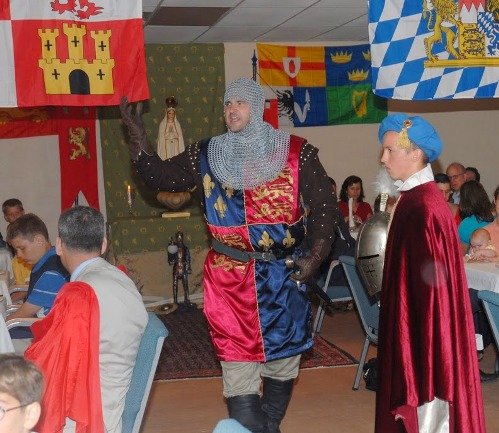 |
| Today’s young Catholic men need true and virtuous Catholic role models to admire and imitate. |
The camp encourages its participants to not only look up to true role models but to become leaders like them as well. Canoe runs, obstacle courses, and group problem-solving drew out the leader in everyone. Games like “French football,” “Shield Ball” and “Capture the Flag,” can only be won through teamwork and strategy.
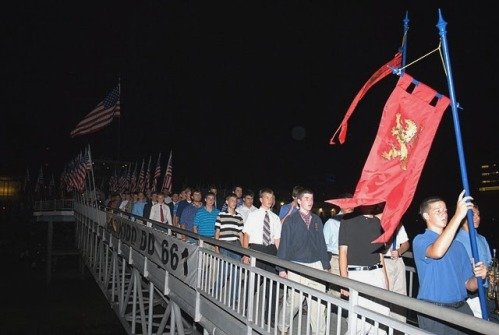 | 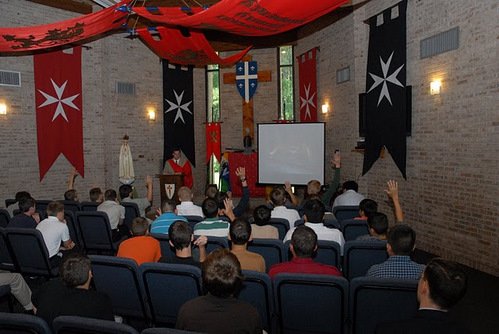 | 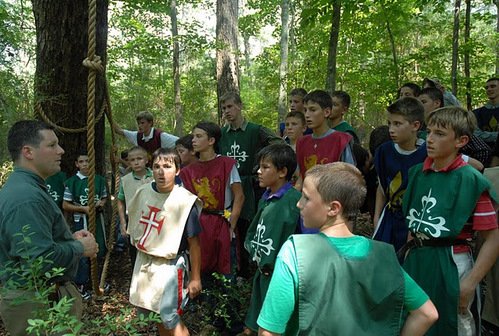 |
| The USS Kidd has many examples of courage and heroism. | Catholic doctrine provides answers and historical figures illustrate it. | Teamwork and camaraderie are also necessary for our youth of today. |
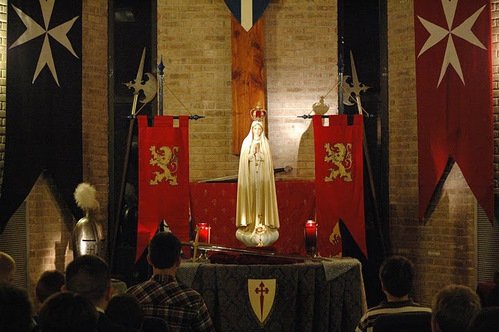 | 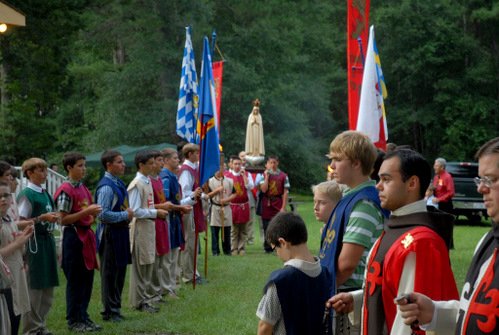 |
| The Vigil of Arms before a relic of the True Cross. | Essential to true formation are the sacraments and an interior life of piety. |
Tuesday, July 19, 2011
Second Chinese "Bishop" Excommunicated
The Vatican has officially announced the excommunication of a Chinese "bishop" consecrated with approval on July 14 in defiance of the Holy See.
This was the second announcement of excommunication of a Chinese "bishop" within the past month, in an escalating conflict between Rome and Beijing which prompted one prominent prelate to say: “This is war.”
A formal statement released by the Vatican on July 16 cited canon 1382 of the Code of Canon Law, which stipulates that anyone involved in consecrating a bishop without approval from the Holy See incurs the penalty of excommunication.
Father Joseph Huang Bingzhang had been warned before the illicit ordination, the Vatican revealed. The statement added that “the Holy See does not recognize him as bishop of the diocese of Shantou, and he lacks authority to govern the Catholic community of the diocese.”
In the same statement, the Vatican complained that some bishops had been unwilling to participate in the illicit ordination ceremony, “and also offered various forms of resistance, yet were reportedly obliged to take part in the ordination.” The statement said that Pope Benedict XVI “deplores the manner in which the Church in China is being treated.”
The Vatican praised Chinese Catholics who have resisted the pressure from the government-backed Patriotic Association to accept bishops who are not in communion with Rome. An AsiaNews report cited examples of that resistance:
Bishop Paul Pei Junmin of Liaoning was selected by Chinese authorities to be the principal celebrant at the July 14 ordination ceremony. But the bishop refused to participate, and the priests of his diocese surrounded him, inside his cathedral, to prevent authorities from arresting him and transporting him to Shantou for the ceremony.
In Guangdong, 4 bishops were taken into custody and accompanied by police to the ceremony. But when they finally freed to return to their own dioceses, they had the Vatican’s July 16 statement read to all the faithful.
In Harbin, staunch resistance by the faithful has forced the Patriotic Association to postpone another scheduled ordination.
The present battle is within the Chinese Church—between a faction that takes orders from the government and another faction that insists on independence from Beijing and loyalty to the Holy See. Cardinal Joseph Zen, the former bishop of Hong Kong, referred to the conflict as a "war" remarking: “You can start a new church, but don’t call it a Catholic church.”
Subscribe to:
Posts (Atom)
